Article from Country Style, March 2004
Messages in stone
If the words of the poets speak to you around the countryside, this is the man behind them.
Words by Ali Gripper. Photography by Andrew Lehmann.
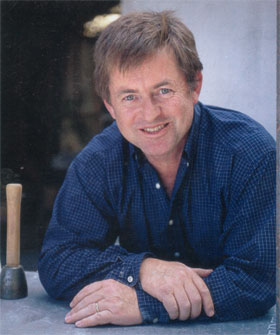 Ian Marr is fast becoming the Arthur Stace of rural
But unlike Stace’s chalk art work, Ian Marr’s messages will last longer than the next downpour of rain.
A self-taught epigraphist, Ian is warming hearts by carving poetry and literary quotations in stone throughout the
At Mildura, the spirit of the
Stroll through the Orange Botanical Gardens and where the path splits into two, you’ll be charmed by one of the artist’s stone benches adorned with words by the American poet Robert Frost:“Two roads diverged in a wood and I – I took the one less travelled by and that has made all the difference.”
Ian’s songlines in stone can also be found in homes. Above the artist Tim Storrier’s fireplace, in his home in
“You can reach people’s imaginative life in a special way through this medium,” says Ian, a warm and intelligent man who obviously searches for a deeper meaning in life through literature, myths and art.
His commissions range from stone tables and school memorials to park benches and tree plaques. He didn’t exactly expect business to boom - taking up epigraphy was more a matter of following his heart, and his passion - but the work keeps rolling in, and the last few years have been enormously productive.
“It’s fascinating in a way. I do believe this medium touches people,” says Ian. “I’m often amazed at the depth of people’s response.
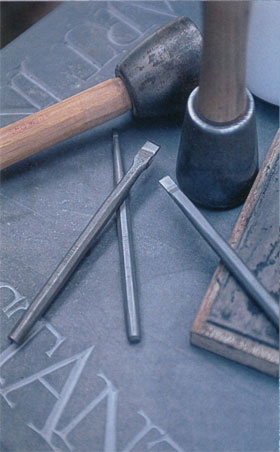 “The appeal for me,” he says, flicking an autumn leaf off one of the slate tablets lying in his studio, “is that it has the illusion of being a more enduring art form.
“Words are so fleeting, like everything else in the world, but you can give them a life of their own by carving them.”
Many of Ian’s clients bring favourite quotations to be carved, but if they don’t, Ian has a storehouse of literary inspiration. He studied English and History at the
A favourite among customers, he says, is the line from Camus: "In the depths of winter, I finally learned that there lay in me an unconquerable summer.”
Other popular orders are witty ones written by Ian, such as “You have no messages” or “Virgil Reality”.
“The stone work has given new life to my reading. I read with a purpose, with an ulterior motive,” he says.
Cutting letters in stone reached its zenith in early
Epicurus is known to have had a stone tablet laid in his garden, carved with the words meaning: “This garden does not whet your appetite but quenches it.”
Ian explains this while taking a break in his open-air studio in the back of his home in Orange, New South Wales, where he lives with his wife Penny and their two children, Isobel, 15, and Thomas, 13.
Here, in
One private commission in the southern
“You have to be there to feel its presence, but as you read those words, and look out to the distant hills...,” says Ian. Enough said.
Ian loves the physicality of working with stone, particularly slate, or of hunkering down over a beautiful new slab, drawing the letters with Faber Castell pencils and then carving them out.
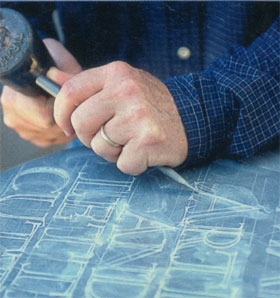 Mostly he uses slate, a stone he describes as “extraordinary”, and which he sources from a quarry outside the
“I’ve never found a material so inherently beautiful; it’s evanescent, especially as it changes from wet to dry,” he says.
Each copperplate word is a thing of beauty to him, and indeed, to gaze upon just one elegantly carved letter of one of Ian’s stone tablets is to see with fresh eyes just how beautiful the English script can be.
“Sometimes 1 work right through the night, it’s like a rhythmic activity. When you’ve got a few years of experience, you develop an affinity with stone.”
Good art takes time, he says. The creative process is helped by long times of “moodling” ‑ quietly turning a project over and over in his mind, as he is going about his daily business, droving stock or taking long drives. (Ian regularly drives the 750 kilometres from
“The need to express oneself is a powerful urge. It’s a compulsion,” he says. “For some people it’s art, or poetry. Mine is to carve letters in stone.”